
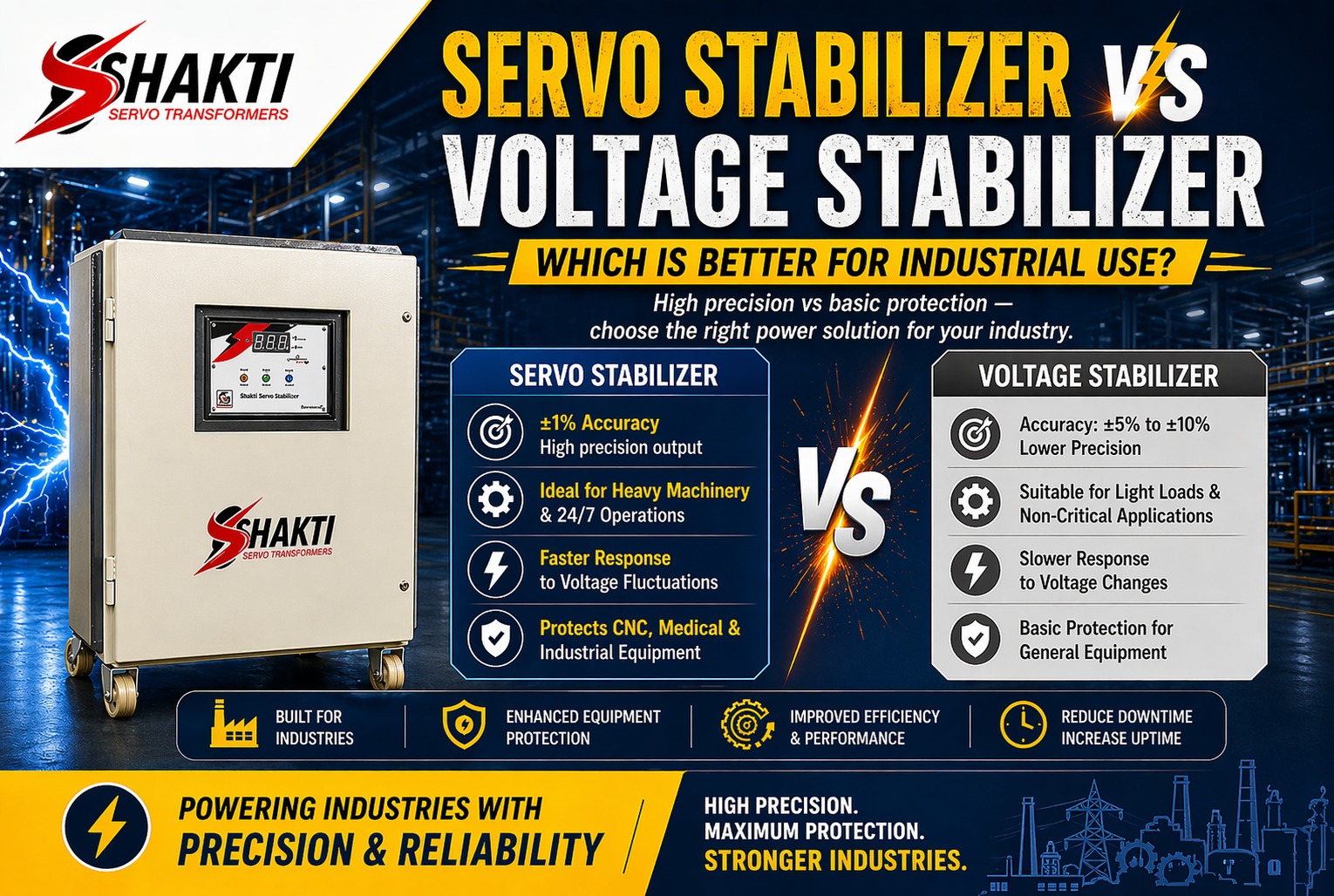
Industrial processes require a continuous power supply to operate machines smoothly without damage. Variations in voltage can result in costly repairs and lost downtime. The Voltage Stabilizer and Servo Stabilizer are the two most popular protective systems. Both are intended to control voltage, but they work in different ways.
A standard voltage stabilizer is also known as a relay-type or static stabilizer. It is based on a transformer and uses relays as its main components. As the input voltage changes, the relays move to different transformer taps to restore the voltage to a safe range.
These are generally used for small appliances or domestic purposes. Their response is usually too slow for industrial settings. Because they work in steps, the adjustment is not always exact. For example, if your equipment requires exactly 230V, a standard voltage regulator may supply 220V or 240V, depending on the closest step voltage.
A Servo Stabilizer is an evolved technology used for precision-driven industrial applications. It uses a servo motor for voltage correction. A motor rotates a variable transformer, also known as a Variac, to keep the output constant as the input voltage increases or decreases.
The correction in a Servo Stabilizer is continuous and smooth. The voltage does not increase in steps or sudden jumps. This is why it is preferred for costly and delicate industrial equipment.
A servo stabilizer offers a high degree of accuracy, typically better than ±1% at the output voltage. Some voltage stabilizers have an accuracy of ±5% to ±10%, which may not be suitable for sensitive devices such as CNC machines, medical equipment, and precision industrial systems.
Industrial customers regularly experience high-capacity voltage spikes. This is where a servo stabilizer performs better because it corrects voltage quickly and smoothly. A relay-based voltage stabilizer, on the other hand, can suffer from a delay in switching time.
Standard stabilizers are recommended for lighter loads. A servo stabilizer is designed for heavy-duty motors, high KVA ratings, and large factories. It can run continuously and handle demanding industrial conditions more effectively.
The cost of a basic voltage stabilizer cannot be justified when industrial accuracy and equipment safety are more important. Small voltage fluctuations can negatively impact industrial machines. Using a servo stabilizer extends equipment life, saves energy, and reduces the risk of fire or short circuits.
For industries, the main benefit of a servo stabilizer is stable and precise output voltage. This helps machines perform consistently, reduces unexpected breakdowns, and protects expensive equipment from voltage-related damage.
Choosing the right protection for your machinery is crucial if your business is to grow. For small requirements, a standard voltage stabilizer may be enough, but for industrial applications, a servo stabilizer is the clear winner.
For reliability, Shakti Servo, as a leading Servo Stabilizer Manufacturer, offers premium quality power solutions. Shakti Servo systems are user-friendly and suitable for difficult industrial conditions. With years of service, Shakti Servo provides reliable systems that protect machines from unexpected power outages and power surges, helping ensure productivity stays at 100%.